
The Checklist Library
The part that takes twenty years, not two weeks.
Anyone can build a form. What makes a firm productive on day one is having the right questions already written — in the order the assembly is built, in the words a reviewer uses on site.
Coverage
What's in the library today.
The envelope, end to end — from the substrate the waterproofing lands on to the traffic coating walked on afterwards.
Below grade & waterproofing
- Substrate preparation
- Below-grade waterproofing
- Self-adhered membranes
- Cold-applied membranes
- Hot rubberized asphalt (HRA)
- Vapor barriers
Roofing & horizontal
- Roofing assemblies
- Sheet metal flashing
- Traffic coating
- Drainage & terminations
Walls & openings
- Air & weather barriers
- Opening waterproofing
- Cladding
- Sealants & joints
Mock-up reviews
- Window mock-ups
- Wall mock-ups
- Door mock-ups
The reviews that set the standard for everything built after them.
Field testing
- AAMA 501.2 — hose testing
- AAMA 502 — installed fenestration
- AAMA 503 — storefront & curtain wall
One category, not three lists: the procedures differ in timing and cycling, and the water methods stay in standard order.
Recorded step by step, with a status, a note and a photo at each stage of the procedure.
Preconstruction meetings In progress
- Transitions & terminations
- Sequencing between trades
- Mock-up & testing expectations
- Submittals & compatibility
The envelope items that have to be settled before anyone builds — reviewed in the meeting, against a list, rather than remembered afterward.
Evaluation & condition survey
- Building envelope, roof, wall
- Window and door, cladding
Written for existing buildings: each component rated Good, Fair, Poor or Failed, with an anticipated service life range behind the rating and a Repair Inventory at the end.
Manufacturer context
Common envelope manufacturers are built in, so a report can name the system under review without a reviewer typing it from memory on a windy roof.
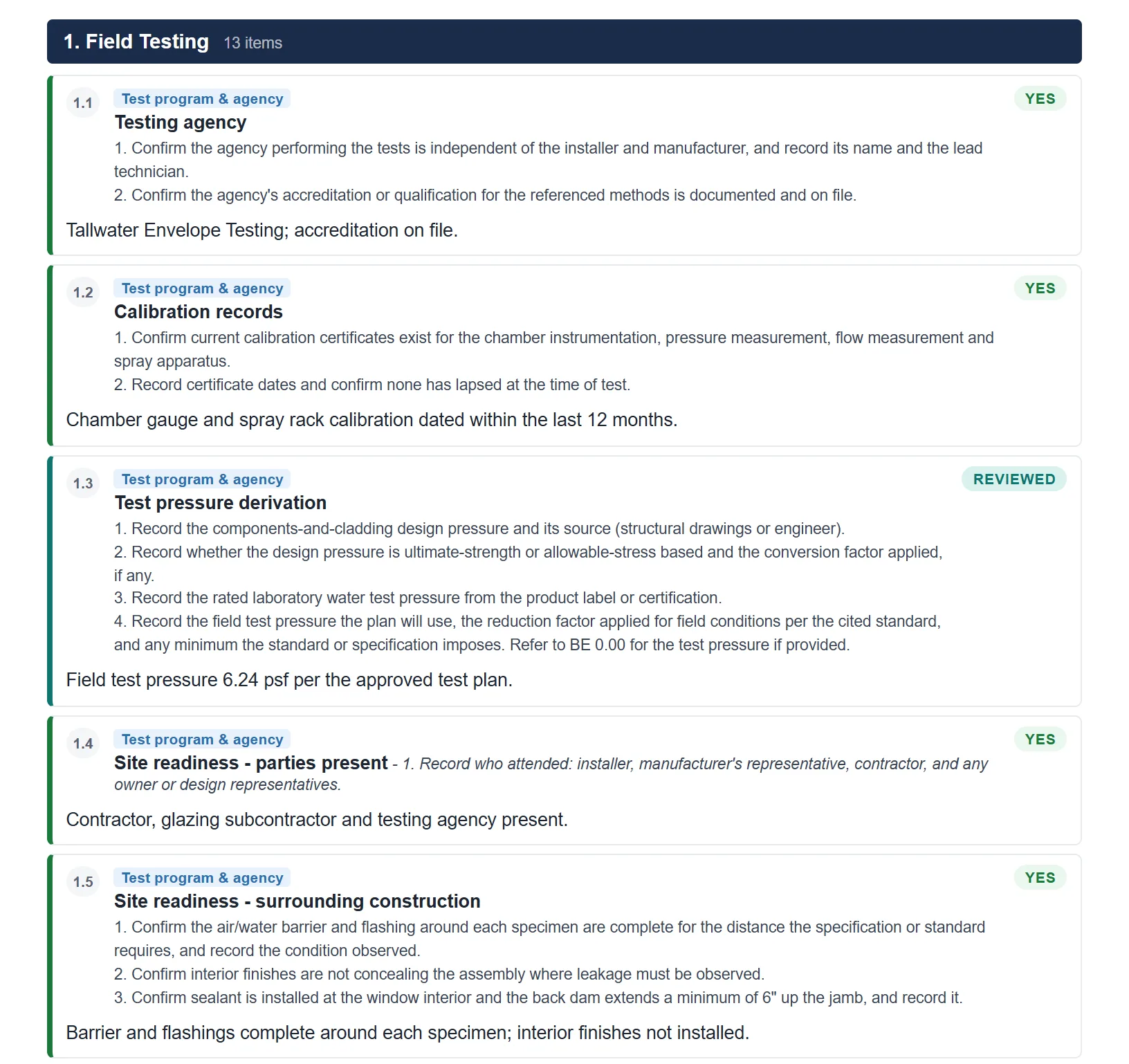
In the report
What a library item looks like once it is written up.
The wording an observer reads on the device is the wording that prints for the client — the requirement, then what was actually found.

How it's written
Questions an observer can read once, on a roof.
The library is maintained by a practicing consultant who has had to defend these observations in a meeting. That is the test every item is written against.
Each item names what it is checking against — the standard, the manufacturer’s published instruction, or the project’s own specification — so a reader can go to the source rather than take the item on trust. The wording is edited for the field: short enough to read in wind, in the order the assembly is actually built.
Systems are built around what the manufacturers publish. If your scope is to review against the manufacturer’s specification, the standard library already does that work.
- Ordered by assembly, not alphabetically
- Written for the field — short enough to read in wind
- Every item names its source, so you can check it
- Edited continuously, and reviewed quarterly as practice and products move
What an item looks like
Illustrative of the style. Actual items vary by system.
Four ways to hold the library
From "use ours" to "we'll encode yours."
Most firms start with the library as shipped and never move. The ladder is there because some firms have their own standards and want to hold them.
| Tier | What you get | Who it's for |
|---|---|---|
| Stock | The library exactly as we ship and maintain it, updated quarterly. | Most firms. Included with every subscription. |
| Branded | Your terminology, your section names, your report cover — configuration, not rewriting. | Firms with an established house style. |
| Custom-authored | We encode your firm's own standards into the library as a service engagement. | Firms whose standards are a competitive asset. |
| Self-maintained | You receive your own editable library workbook and maintain it in-house. | Larger firms with a technical director who wants the pen. |
Read the library on a real screen.
Ask us and we’ll show you a working slice of the library, so you can judge the wording yourself rather than take our word for it.